
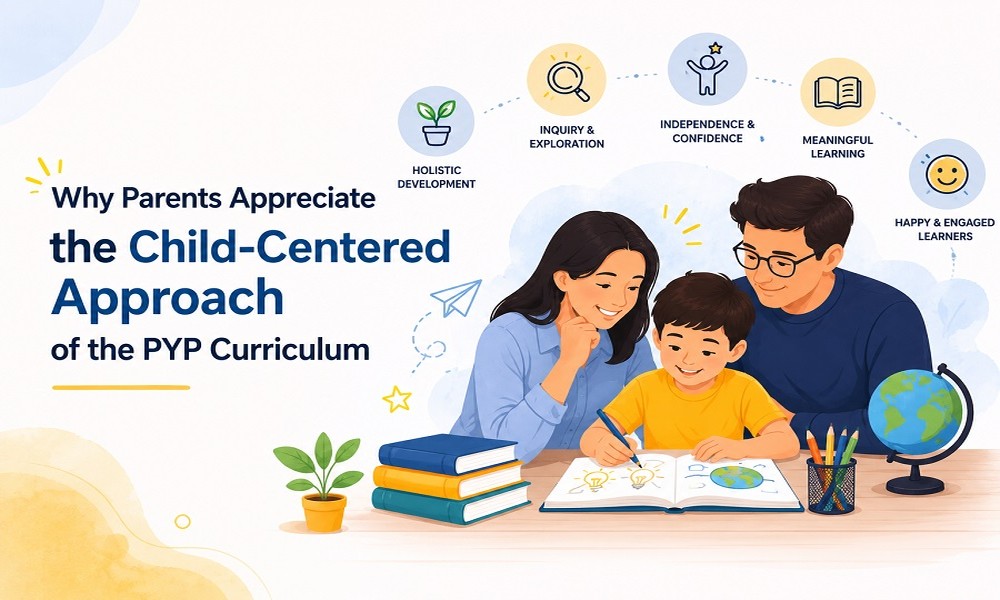
The Primary Years Programme (PYP) is widely recognized for its child-centered philosophy, where learning is designed around the needs, interests, and developmental stages of young learners. Unlike traditional methods that focus mainly on rote learning, the PYP encourages curiosity, exploration, and meaningful understanding through inquiry-based education. This approach helps children build strong conceptual foundations while developing confidence and independence from an early age.
One of the key reasons parents value the IB MYP learning pathway is its natural progression from early inquiry-based learning into more structured critical thinking and concept application. In the earlier years, children experience learning that is highly interactive and student-driven, which prepares them well for the increasing academic depth and analytical expectations they encounter later. This continuity within the IB framework reassures parents that their child is not just memorizing content, but developing lifelong learning skills step by step.
A major strength of the PYP approach is its emphasis on the whole child. Academic growth is balanced with social, emotional, and physical development, ensuring that children do not feel overwhelmed by academics alone. Through collaborative projects, hands-on activities, and real-world connections, students learn to communicate effectively, work in teams, and express their ideas with clarity. These communication skills become especially important as they transition into advanced stages of the IB MYP, where presentations, research tasks, and discussions play a bigger role in learning.
Parents also appreciate how the PYP builds learner independence. Instead of relying solely on teacher instruction, children are encouraged to ask questions, investigate topics, and reflect on their learning. This sense of ownership helps them become more responsible and self-motivated. Over time, this independence supports smoother adaptation to the IB MYP, where students are expected to manage assignments, think critically, and connect ideas across subjects.
Another important aspect of the PYP curriculum is its focus on real-world learning. Lessons are designed around global themes that help students understand how their learning connects to everyday life. Whether exploring environmental issues, cultural diversity, or scientific concepts, children develop a broader perspective of the world. This global mindset is highly valued by parents, as it prepares students for future academic challenges in the IB MYP and beyond.
Assessment in the PYP is also more flexible and supportive compared to traditional systems. Instead of relying heavily on exams, children are evaluated through projects, observations, presentations, and reflective tasks. This reduces pressure while allowing teachers to understand each child’s progress in a more meaningful way. Parents often find this approach reassuring, as it highlights growth and development rather than competition and ranking.
The strong communication between school and parents is another reason why families appreciate the PYP. Regular feedback, learning updates, and collaborative involvement ensure that parents remain active participants in their child’s educational journey. This partnership strengthens the learning experience and builds trust in the overall system.
In conclusion, parents appreciate the child-centered approach of the PYP curriculum because it nurtures curiosity, independence, and holistic development while laying a strong foundation for future academic success. Its seamless alignment with the IB MYP ensures that children transition smoothly into more advanced learning stages with confidence, clarity, and well-developed skills that prepare them for lifelong learning.
